
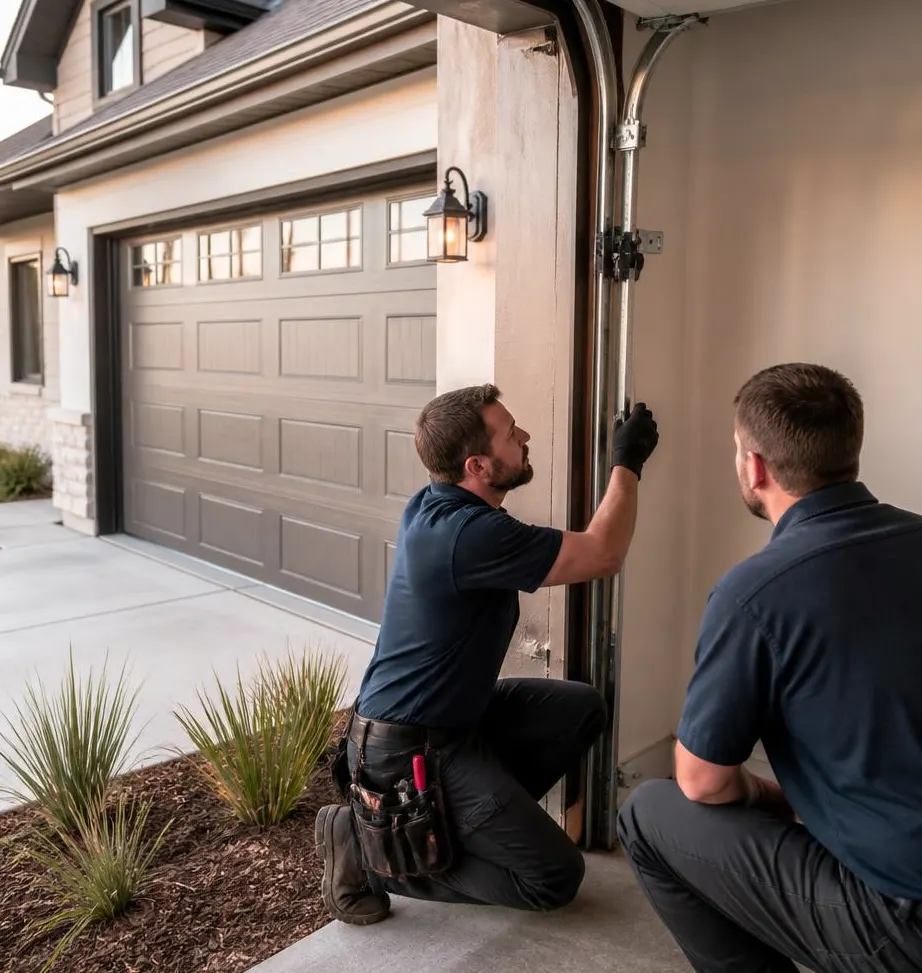
A typical call starts the same way: the homeowner says the door was fine last week, then suddenly it felt heavy to lift, or the opener started straining and grinding before the door would budge. Sometimes there was a loud bang from the garage a few days earlier that everyone assumed was a slamming door or a storm gust. By the time a technician gets there, the torsion spring often has a visible gap in the coil, or one of the extension springs has stretched far past where it should sit. In almost every case, there were signs days or weeks before the spring actually gave out.
Springs don't usually fail without warning. Between the hot summers, dusty winds, sudden hailstorms, and the occasional hard freeze that reaches up through places like Boerne and New Braunfels, the metal in these springs goes through a lot of expansion, contraction, and grit exposure over the year. That stress shows up as small clues before the spring actually snaps. Here's how to check for them yourself.
Walk the Garage Checklist
1. Look at the torsion spring coil above the door
With the door closed, look at the spring (or springs) mounted horizontally above the door track. A healthy spring has tightly wound, evenly spaced coils with no visible gap. If you see a clear separation in the coil, even a small one, that spring has already partially failed and could let go completely at any time. Stop using the opener and call for a repair rather than testing it further.
2. Check for rust, flaking, or pitting
Run your eyes (not your hands) along the length of each spring. Surface rust, flaking metal, or a rough, pitted texture means the spring has weakened from moisture and dust exposure. A spring in this condition has lost tensile strength even if it hasn't snapped, and it's more likely to break under normal use.
3. Do the manual balance test
With the opener disconnected (pull the release cord), lift the door by hand about halfway and let go. A door with good springs will stay roughly in place. If it drops on its own, or shoots upward, the springs are no longer holding proper tension. This is one of the clearest signs of wear, and it also means your opener has been doing extra work it wasn't built for.
4. Listen to the opener motor
If the opener strains, hesitates, or reverses partway through a cycle, it's often compensating for springs that can't fully support the door's weight anymore. This also shortens the life of the opener itself, so a weak spring can turn into a second repair if it's ignored.
5. Watch how the door travels
Open and close the door slowly and watch both sides. If one side lifts faster than the other, or the door looks crooked or tilted as it moves, one spring (on a two-spring torsion system) or one extension spring is likely weaker than the other. Uneven tension puts extra strain on the cables, tracks, and rollers too.
6. Check extension springs for overstretching
If your door uses extension springs (the kind that run along the horizontal tracks rather than above the door), look for springs that appear stretched well beyond their coiled length even when the door is closed. Overstretched extension springs are close to failure and are also more dangerous if they let go without a safety cable in place.
7. Note any recent loud bangs
A sharp bang from the garage, especially one that happened during temperature swings or right after a storm, can mean a spring partially failed without the door seeming to stop working. If you've heard this and haven't had the springs inspected since, treat it as a warning, not a one-time fluke.
8. Think about how long the springs have been in service
Standard springs are rated by cycle count (one cycle equals one full open-close), and most wear out well before a homeowner expects. If you don't know when the springs were last replaced and the door sees daily use, age alone is a reason to have them checked.
When to Call San Antonio Garage Door Service
If you notice a coil gap, rust, uneven travel, or a door that won't hold its position during the balance test, stop operating the door and call us. We handle spring replacement for both torsion and extension systems, matching the new springs to your door's weight and cycle needs rather than guessing. If the springs still look sound but you want peace of mind before summer heat or the next big storm rolls through, our garage door maintenance and tune-up service checks spring tension, hardware, and balance in one visit.
If any of these signs match what you're seeing in your garage, give San Antonio Garage Door Service a call. We serve San Antonio, Schertz, Converse, Live Oak, Selma, Universal City, New Braunfels, and Boerne, and we'll get your door back to safe, balanced operation without surprise fees.